LHCb Completes Family of Doubly Charmed Baryons with Discovery of Long-Predicted Particle
New CERN result follows the discovery announced by IAS guest Dr. Vincenzo Vagnoni earlier this year


The LHCb Collaboration at CERN has announced the discovery of a new particle composed of two charm quarks and one strange quark, completing the family of doubly charmed baryons that physicists first predicted more than fifty years ago. The result marks an important milestone in the study of the strong force, which binds quarks together to form matter.
The newly observed particle, known as the Ωcc⁺ baryon, was identified using data collected in 2024 with the upgraded LHCb detector. Like other doubly charmed baryons, it is extremely short-lived and was detected through the traces left by its decay products. The discovery completes a trio of particles containing two charm quarks and a third quark — up, down, or strange.
The finding follows the discovery of the Ξcc⁺ baryon announced by the LHCb Collaboration in March 2026. That result, led by Dr. Vincenzo Vagnoni, spokesperson of the collaboration and guest of the Institute for Advanced Studies in May 2025, represented the first new particle discovered using the upgraded LHCb detector. Together, the two discoveries complete the known family of ground-state doubly charmed baryons.

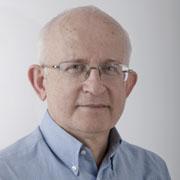
Dr. Vincenzo Vagnoni and former IAS Director Prof. Marek Karliner, May 2025
The study of particles containing multiple heavy quarks remains an active area of research at Tel Aviv University. Related theoretical work by Prof. Marek Karliner, former Director of the Institute for Advanced Studies, contributed to the understanding of heavy-quark hadrons, including exotic tetraquark states later confirmed experimentally at CERN. His research has helped advance the broader effort to understand how quarks combine to form the rich spectrum of particles observed in nature.
Researchers will now use future LHCb data to measure the properties of the newly discovered particle with greater precision and to search for additional heavy baryons and other previously unobserved states. The upgraded detector and the future High-Luminosity Large Hadron Collider are expected to expand these searches in the coming years.
The IAS congratulates the LHCb Collaboration on this important achievement and looks forward to future discoveries that deepen our understanding of the fundamental building blocks of matter.
Related Articles